

The 250th

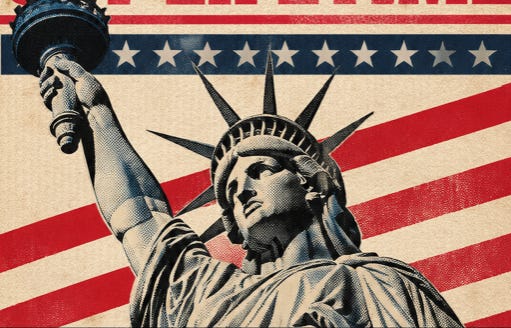
As an immigrant to this country in 1980 at age 40, I celebrate the 250th, and reminisce. As a child growing up in Cambridge England in the 1940s my mother would mention ‘the Yanks’ as our lifeline. Our food depended on American cargo ships getting across the Atlantic without being torpedoed by German subs. ‘Petrol’ (gasoline) too. Ration cards specified the maximum we could legally buy per week by way of meat, flour, dairy products etc. Store shelves were often empty so ‘rations’ were sometimes just unfulfilled government promises. I’m 5’9” but my father, grandfather, mother and sons have all been taller so I’ve always blamed wartime malnutrition for denying me several inches — a trivial loss comparatively. And I only mention it to underline how we Brits depended on the US.
The Americans had their faults to be sure. They had been too slow to join with us in the life and death struggle against the Nazis, my family thought. But they did the right thing eventually. And when Americans decided to help, they could help bigtime. Refugees from ‘the Continent’ the Poles, French, Czechs, Hungarians, Finns, even the German refugees like my father were very motivated. They knew the enemy and brought great smarts and spirit to the war effort. But America was the indispensible ally. The USA had numbers. So when it came to D-Day and invading Nazi-controlled France the Yanks more than matched British Commonwealth/European Resistance numbers — 22 US divisions to seventeen British & allied. Same with kit, gear, stuff. The US was the world’s great manufacturer, the China of the day. Ships, cars, guns, machine tools, planes, sewing machines, ammo, fridges, clothing, meat. You name it, the Yanks could make it and make it in volumes that no one else could match. They lived well.
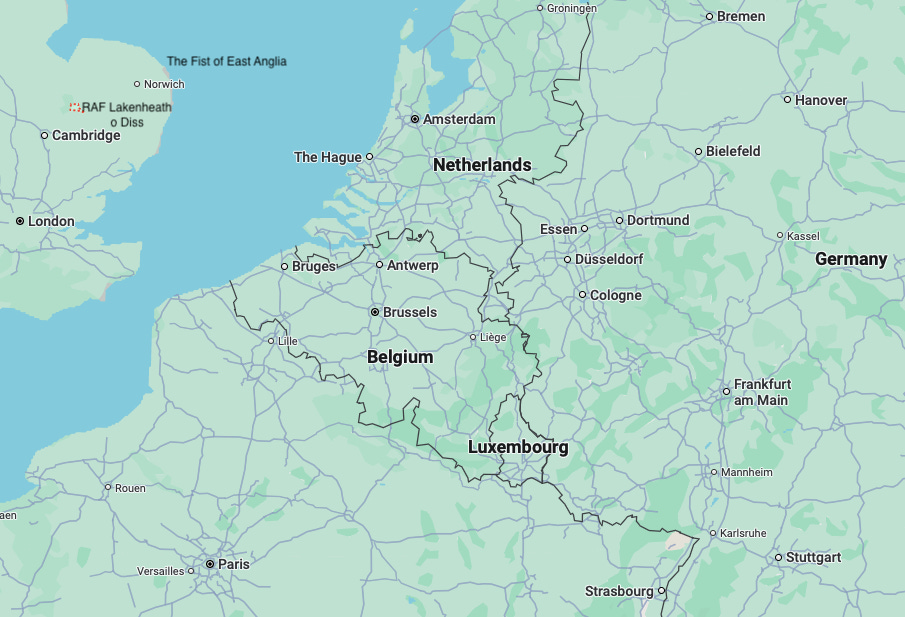
My mother and her sister (my Aunt Jean) were daughters of a highland Scot farmer who had emigrated to ‘the Fens’ of East Anglia east of Cambridge. They talked of the Yanks, soldiers and airmen who had flooded into nearby towns like Cambridge, Ely, Thetford, Norwich, Diss, Ipswich, Bury St Edmunds and Newmarket. Aunt Jean was single and had gone into the Royal Air Force (RAF) and been given a crash course in aircraft maintenance.
East Anglia is the fist of England that reaches northeast into the North Sea so it was where allied air power was assembled. My Granpa Drummond in Diss, Norfolk had most of his farmland taken for an airfield. There were scores of hastily built, vast concrete slabs of runways floating in the marshy countryside of the East Anglia fist. My Aunt Jean worked on the Spitfires, Hurricanes, Mustangs, and Lightnings at a couple of airbases. One of these I’m pretty sure was RAF Lakenheath, to this day an important NATO airbase, and used just months ago for staging US aircraft bombing Iran.
I overheard Aunt Jean’s stories of dealing with beaten up airplane machinery, patching stuff up and wondering whether it was fit to be sent aloft again. or was the risk to the airmen too great. She also regaled my mother with stories of the wild partying with the airmen themselves in their time off between sorties. Jean never married and my mother used to joke that Jean had never been able to ‘settle down’ because of all her libertine liaisons with those Yanks during the war.
Another single aunt Else, my father’s sister also spent the war with the RAF and was sent to British Mandate Palestine to an airbase in what was to become Israel. Like my father she’d grown up totally German, unaware of any Jewish heritage but forced in the 1930s to flee to England because of ancestral family names on the Nazi list of ‘non-Aryans.’ The irony then of Else randomly assigned to RAF service in Palestine and hooking up with a ‘Palestinian,’ a Palestinian Jew. And seriously. And converting to Judaiism so she could marry him and settle in the Jewish state.
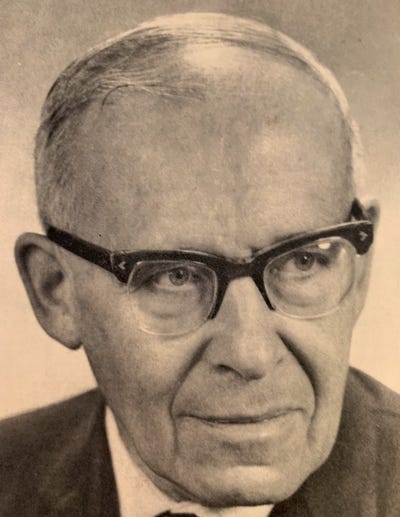
My father (above c 1963) as a refugee from the Nazis had the satisfaction of going back into Germany after they’d been defeated and participating in the ‘denazification’ of schools and universities in the British Sector of Occupied Germany — working up lists of Nazi teachers to be dismissed and barred from teaching again and adoption of liberal, non-racist curricula. He thought his counterparts in the French and Soviet sectors were vindictive and crude. The Yanks he thought “did a pretty decent job” of denaziification in their sector but quite not up to British standards. He’d become very British! Though you’d never know it from the mocking he got from the family for the difficulty he had with making the ‘th’ sound. It always came out a ‘zah.’
But he was British enough that on being demobilized from the Army he focussed a job search to the British world, no longer Empire, now Commonwealth. He got offers from Cape Town S Africa and Melbourne Australia. The racial divide made S Africa too dicey. So when I was seven we moved to Australia’s then free state Victoria, the home of free immigrant, entrepreneurial people. Gold seekers had always set out from Melbourne and made it their home. Sydney was where the British had sent their crims and where an annoying kind of jail socialism still hung around.
For me America was always the intellectual mecca. My music was American jazz. Most books and magazines worth reading were American. In B Econ at Melbourne U the textbooks were by economists like Paul Samuelson of MIT, Milton Friedman Uni Chicago, Thomas Sowell of Cornell. I found the egaliarianism of American ideals an ethical beacon. Its constitution brilliant. I despised the absurd ‘strine relics of British monarchy and aristocracy, the ceremonial figure of a Governor-General and of Knights, blah political cronies who got the title Sir, and expected some special respect.
As a teenager my heroes were mostly Americans, like the eloquent Martin Luther King we saw in newsreels and on TV. Americans were a bit weird tho, for example calling him Junior. For us Junior was a demeaning title for anyone over the age of 10 or 11.
To this day I simply refuse to use the suffix Jr for an adult, especially one I admire or respect. Just as to this day you’ll never have me call Democrats blue or Republicans red. How could Yanks get the political colors so mixed up. Where I grew up a real conservative was ‘true blue’ and red was the socialist color. Hence the song they’d sing at drunken parties which begins: “The people’s flag is deepest red...”
Only drunks and potheads were socialists then.
America was an ideal because it seemed to have managed, at least in this time, to be righting old civil rights wrongs through non-violent confrontations. The sit-ins against segregation. The refusal to go to the back of the bus. The simple demand that all, everyone here, every American is entitled to the rights asserted in the Declaration of Independence. No half decent argument could counter that, especially when delivered with the eloquence of King in his ‘I have a dream speech.’
Political eloquence, we read had helped rally the troops in the harsh winter five months after the Declaration, in Tom Paine’s:
“These are the times that try men’s souls. The summer soldier and the sunshine patriot will, in this crisis, shrink from the service of their country; but he that stands by it now, deserves the love and thanks of man and woman. Tyranny, like hell, is not easily conquered; yet we have this consolation with us, that the harder the conflict, the more glorious the triumph. What we obtain too cheap, we esteem too lightly: it is dearness only that gives every thing its value. Heaven knows how to put a proper price upon its goods; and it would be strange indeed if so celestial an article as freedom should not be highly rated. Britain, with an army to enforce her tyranny, has declared that she has a right (not only to tax) but “to bind us in all cases whatsoever” and if being bound in that manner, is not slavery, then is there not such a thing as slavery upon earth. Even the expression is impious; for so unlimited a power can belong only to God.”
Paine of course was a Brit immigrant.
https://www.ushistory.org/Paine/crisis/c-01.htm
But none can surpass in American eloquence the utterly American Lincoln in Gettysburg:
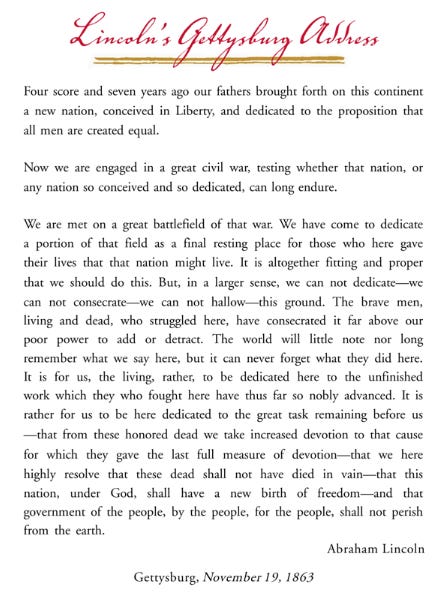
George Will’s reading of it is pretty good:
What a country! Many happy returns, America!
PSam 20260704